|
Physics
Einstein's contribution to 20th century physics is uncontested and
has been described in countless publications of all kinds. He is probably
best known for his Special and General theories of Relativity. But his
scientific works also include papers on theoretical mechanics, on quantum
theory, and important contributions to cosmology. Einstein's revolutionary
ideas touched off heated debates, and not only among the scientists in
his own field. Many philosophical articles, for example, have also dealt
with his theories.
Scientific
Papers
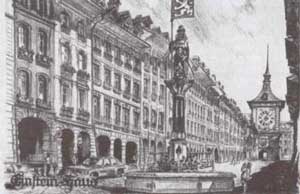
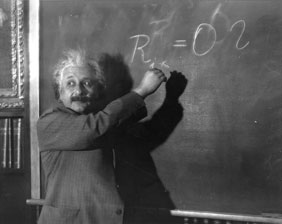
In 1905, while living at Kramgasse No. 49, Albert Einstein developed the
Special Theory of Relativity. His work on the General Theory also began
in Bern.
| 
|
Einstein
himself called the years from 1902 to 1909 the happiest and most fruitful
period in his life. He presented no less than 32 scientific publications.
Six of them stand out in particular: the fundamental papers Einstein
published as a 26-year-old in 1905, the year of his breakthrough:
On
a Heuristic Point of View Concerning the Production and Transformation
of Light
(For this paper on the photoelectric effect he received the Nobel
Prize of 1921.)
On the
Movement of Small Particles Suspended in Stationary Liquids Required
by the Molecular-Kinetic Theory of Heat
(On a problem in statistical mechanics)
On the
Electrodynamics of Moving Bodies
(Special theory of relativity)
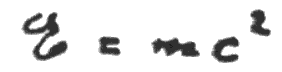
Does
the Inertia of a Body Depend upon Its Energy Content?
(Equivalence of mass and energy)
On the
Theory of Brownian Motion
(Published in 1906)
A New
Determination of Molecular Dimensions
(His doctoral dissertation)
Thus,
Bern became the starting point of a unique academic career. The year
1905 - often called his "annus mirabilis" - was the most creative
period of scientific endeavours for Einstein (and for the whole community
of physicists). His theories were received very sceptically at first.
Today they are an indispensable part of physics. The consequences of
the theory of relativity, for instance, are confirmed daily by modern
acceleration experiments.
Family
In
1903, Albert Einstein married Mileva Maric against the will of their parents.
The two had met while studying at the ETH (Federal Institute of Technology)
in Zurich. Mileva, originally from Serbia, had come to Switzerland to
study, encouraged by her father, who was aware of her exceptional intellectual
abilities. Mileva was one of the first women ever to enrol at the ETH
for physics.
In 1902 she gave birth to a girl, Lieserl, whose fate remains largely
in the dark. In 1904 Hans Albert was born. He became an engineer, and,
in 1937, a professor of hydraulic engineering in Berkeley, California.
Friends
Einstein's
most important friends and partners in discussion were Maurice Solovine
and Conrad Habicht. Together they founded the so-called "Olympia
Academy," having, as its purpose, the discussion of philosophical
and scientific problems. Einstein kept up these contacts after his departure
from Bern.
With another lifetime friend, Michele Besso, Einstein often discussed
scientific matters on the way home from the Patent Office.
Work
at the Patent Office
In
June 1902, Einstein started work as a "technical expert third class"
at the Patent Office in Bern. He had been recommended by his friend, Marcel
Grossmann. In 1906 he was promoted to "expert second class."
His bread-winning job left him enough time for his scientific work. In
1908 he lectured at Bern University, and in 1909 he resigned from the
Patent Office in order to take up the post of associate professor of theoretical
physics at Zurich University.
|
Chronology
|
1879
|
Albert
Einstein is born in Ulm (Germany) on 14 March. He is the first
child of Hermann and Pauline Einstein-Koch. |
|
1880
|
His
family moves to Munich. |
|
1881
|
Birth
of Albert's sister Maja. |
|
1888
|
"Luitpold-Gymnasium" |
|
1894
|
Albert's parents move to Pavia and Milan. He stays in Munich. |
|
1895
|
Albert
arrives in Switzerland. |
|
1896
|
"Matura"
exams at the cantonal school in Aarau. Albert starts studying
physics and mathematics at the Polytechnic in Zurich (ETH). |
|
1900
|
Diploma
as a teacher in mathematics and physics. |
|
1901
|
Swiss
citizen, assistant teacher at the "Technikum" in Winterthur. |
|
1902
|
Albert
moves to Bern and starts work at the Swiss Federal Patent Office
in Bern as a "technical expert third class." The "Olympia
Academy" is founded. |
|
1902
|
Birth
of Lieserl. |
|
1903
|
He
marries Mileva Maric on 6 January. |
|
1903
|
They
take up residence at Kramgasse No. 49 in the autumn. |
|
1904
|
Birth
of Hans Albert. |
|
1905
|
Einstein's
"annus mirabilis": doctoral dissertation, publication
of 5 fundamental papers in the "Annalen der Physik." |
|
1906
|
Einstein
promoted to "technical expert second class." |
|
1907
|
First
attempts to apply the laws of gravitation to the Special Theory
of Relativity. |
|
1908
|
He
gains teaching qualification at Bern University. |
|
1909
|
Resignation
from the Patent Office. |
|
1909
|
Associate
professor of theoretical physics at Zurich University. |
|
1910
|
Birth
of Eduard. |
|
1911
|
Full
professor at the German University in Prague. |
|
1912
|
Full
professor at the ETH in Zurich. |
|
1913
|
Draft
of a generalized theory of relativity, i.e. a theory of gravitation. |
|
1913
|
Member
of the Prussian Academy of Sciences in Berlin. |
|
1914
|
The
Einsteins move to Berlin. His wife, Mileva, and his sons return
to Zurich 3 months later. |
|
1915
|
Einstein
completes the General Theory of Relativity. |
|
1917
|
Health
collapse. First publication on cosmology. |
|
1919
|
Divorce
from Mileva Maric. Einstein marries his cousin, Elsa Löwenthal. |
|
1919
|
Solar
eclipse expedition furnishes proof of the bending of stellar
light in gravitational fields, as predicted by Einstein. |
|
1921
|
Nobel
Prize (Physics) "for his outstanding contributions to theoretical
physics and, in particular, for his discovery of the law of
the photoelectric effect." |
|
1922
|
Member
of the League of Nations' Committee on Intellectual Cooperation. |
|
1929
|
Publication
of the "Unified Field Theory." (Like his later publications
on the same topic it presents no satisfactory solution.) |
|
1933
|
Resignation
from the Prussian Academy of Sciences. Einstein immigrates to
the USA, as many other Jews do.. |
|
1933
|
Professor
at the Institute for Advanced Study in Princeton, New Jersey. |
|
1936
|
Death
of Einstein's second wife, Elsa. |
|
1940
|
American
citizen. |
|
1948
|
Death
of Einstein's first wife, Mileva Maric, in Zurich. |
|
1955
|
Albert
Einstein dies on 18 April, at the age of 76, from a rupture
of his aorta. |
|
|