Einstein
Ceremony 2005 - Presentation of the Laureate
On 9th July, 2005, Murray Gell-Mann, one of the most famous physicists
of the twentieth century, received the Albert Einstein Medal. The Nobel
laureate has made significant contributions to the comprehension of elementary
particle physics.

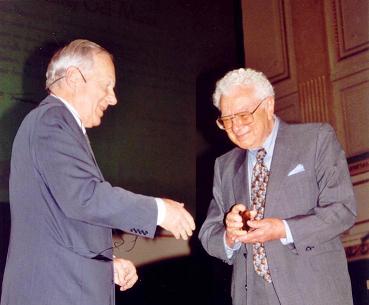
Peter Fricker, Murray Gell-Mann
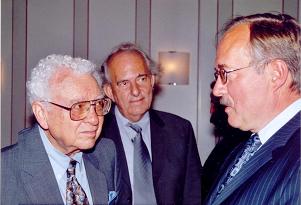
Murray Gell-Mann, Peter Minkowski, Bundespräsident Schmid
Murray Gell-Mann
was born on 15th September, 1929 in New York City. In 1955, he married
the English archaeologist J. Margaret Dow with whom he had two children:
Elizabeth Sarah, born in 1956, and Nicholas Webster, who came into the
world in 1963. Margaret died in 1981. Murray Gell-Mann married Marcia
Southwick in 1992 and has been recently divorced. Today he lives in Santa
Fe, New Mexico.
Gell-Mann's interests extend to many subjects, including ornithology.
history, historical linguistics, archaeology, and creative thinking, all
of which influence his studies on the theory of complex adaptive systems.
Complex adaptive systems (such as tribes, the human immune system, economic
systems) are characterised by adaptability and learning aptitude and pursue
general principles, although they can differ in their concrete physical
appearance. Gell-Mann leaves open the question of whether the development
of complex systems is a process inherent in evolution or accidental. He
is also concerned with how knowledge and understanding are to be extracted
from the welter of information that is available today as a result of
computers and the internet. In his book, "The Quark and the Jaguar,"
Gell-Mann's intention to accommodate particle physics and biological and
cultural evolution, natural selection, biodiversity, the human immune
system, the acquisition of a language or the world economy becomes apparent.
In 1944,
at the age of only fifteen, Murray Gell-Mann began his studies in physics
at Yale University. In 1948, he received his B.S. After working with Enrico
Fermi at the University of Chicago, he changed to the Massachusetts Institute
of Technology. There he earned a doctorate in physics in January 1951
already. In the mid-fifties, Gell-Mann postulated reasons for the "strangeness"
quantum number. Later, as a professor at the California Institute of Technology,
he turned to the theory of weak interactions on one hand to quantum chromodynamics,
which describes the strong interaction between quarks and their gauge
boson, on the other. Professor Gell-Mann retired from Caltech in 1993
and subsequently moved to Santa Fe, NM, where he helped found the Santa
Fe Institute, a scientific research think tank with particular interest
in studying complex adaptive systems.
In 1969,
Murray Gell-Mann earned the Nobel Prize in physics "for his contributions
and discoveries concerning the classification of elementary particles
and their interactions". This is an accurate paraphrase of what he
had achieved in particle physics. Namely in the fifties, new particles
were continually discovered, a progression that continued up to the seventies
and involved the term "particle zoo".
To describe the properties of these proton-like and neutron-like particles
with mostly short chacteristic lifetimes, physicists introduced new "labels",
strictly speaking quantum numbers, in an attempt to sort out the hundreds
of particles. Murray Gell-Mann was a pioneer at this. He introduced the
quantum number "strangeness" on which he made demands already
in 1953, independent from Katsuhiko Nishijima, to describe the peculiarly
long characteristic lifetime of kaons and hyperons. Further progress for
elementary particle classification was the octet model (eightfold way,
following Buddhism) which Gell-Mann and Yuval Ne'eman presented in 1961.
The model made it possible to divide all the hadrons into families with
eight or ten members. Even the neutron and the proton could be classified
in this mathematically symmetric arrangement. Murray Gell-Mann provided
the explanation in 1964, independent from George Zweig: The octet model
can be understood the best when one figures the hadrons based on three
and the mesons based on two even more elementary particles. Gell-Mann
called these "sub-sub-atom particles" quarks, referring to:
"Three quarks for Muster Mark!" from the novel Finnegan's Wake
by James Joyce.
Today the existence of quarks is not in doubt; the first experimental
proof for the substructure of hadrons was produced in 1974. The up-, down-,
strange-, charmed-, bottom - and top- quarks carry electrical charges
of plus or minus one third or plus or minus two thirds of the elementary
charge. Hadrons consisting of three quarks sum, therefore, to either one
elementary charge (as the protons) or two or have no charge (as the neutron).
Every quark carries a so-called colour charge. It is responsible for the
strong interaction, similar to the electrical interaction which is caused
by electrical charges, but more complicated. The strong nuclear force
is mediated by gluons in a similar fashion to how the electromagnetic
force is mediated by photons: It acts between two quarks by exchanging
particles called gluons. There are eight types of gluons, each carrying
a colour charge. This variety increases the number of conceivable combinations
that are limited by restrictions. Similar to chemistry (description which
atoms form which molecules) and nuclear physics (description which nucleus
is formed by what number of protons and neutrons), quantum chromodynamics
describe the cohesion of the baryons and the mesons as well as the nuclear
force between nucleons.
Murray Gell-Mann was involved strongly in the development of quantum chromodynamics
and is therefore considered as one of 20th century's most important theoretical
physicists.
Dr. Hansjörg Friedli
|