The
Awarding of the Albert Einstein Medal 2004
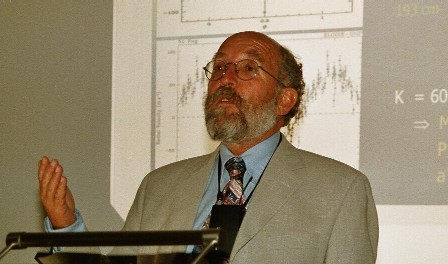
Astrophysicist Michel Mayor from Geneva received the Einstein Medal on
10th June, 2004. Michel Mayor is the co-discoverer of 51b Pegasi, the
first planet found outside of our solar system. His speech entitled “The
Quest for Other Earths” was about the principal procedures in the
quest for exoplanets, about what has been found up to now, and about the
future experiments. This event took place in the hall of the University
of Bern.
When a star orbits another (which applies to about 70% of the stars in
our milky way) one can derive mechanical data, such as revolution period
or masses of this dumbbell-shaped system, by observing the motion of the
brighter star relative to the background. The stars revolve around their
common centre of gravity revealing their existence through regular wobbling.
Because a planet has a much smaller mass compared to the star, the motion
amplitude of the star is very small. If the configuration of both objects
is favourable (from the point of view on earth; see figure 1) it is also
possible to discover such a system by detecting the change of velocity
of the star using Doppler’s effect.
For instance, the star 51 Pegasi has a velocity that is 60 m/s higher
when it approaches the earth compared to the velocity when it turns away
from it 2.1 days later. By means of the celestial mechanics equations,
one can deduce from these data the mass of the exoplanet and its distance
from the star, i.e. its so-called semi-major axis. Here 51b Pegasi differs
clearly from our nine planets: Its orbital period of 4.2 days is 20 times
shorter than Mercury’s, and its semi-major axis is only 4% of the
earth’s semi-major axis. There is no planet in our system which
is so close to the sun! Only its mass is familiar to us: the mass of 51b
Pegasi is about half of Jupiter’s.
Until 2004, slightly less than 2000 solar systems have been investigated.
120 of them possess planets that resemble Jupiter (as described earlier,
with circulation periods between 2.5 days and several years and masses
between 10% and up to 2000% of Jupiter’s mass). Earth-like planets
cannot be detected by using the so-called radial-velocity method. An “exoearth”
would only cause a change of velocity of approximately 0.08 m/s of its
star. Such a small velocity change is smaller by one or two order of magnitude
compared to the "jitter" of the stellar velocity caused by the
magnetic disturbances in its atmosphere.
Another method, the
so-called transit method, also presupposes that the straight line earth-star
is more or less parallel to the plane that contains the exoplanet and
the star. This method is based on the transit of the planet, as figure
1 shows:

Figure 1: The planet’s crossing causes a slight darkening.
Here one makes use of the fact that the planet crosses the star once in
a revolution. During this time, the planet shields a particular percentage
of the stellar in our direction. If the planet’s radius is similar
to Jupiter’s, then this fraction is about one percent.
This luminosity drop of 0.01 is easily detectable and corresponds to the
proportion of the planet’s area to the star’s area.
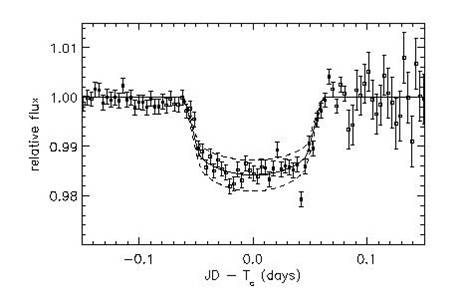
Figure 2: The light curve of HD209458b (period of revolution = 3.5
days, radius = 1.4Rjup, mass = 0.69Mjup)
Fig. 2 shows a typical transit of a Jupiter-like exoplanet. One can see
clearly that the intensity decreases by about 2% as soon as the planet
travels across the star. This covering only lasts for a few hours. One
can calculate the planet’s density of 310 kg/m3 from the data shown
in the figure (compared to the density of water: 1000 kg/m3), therefore
one can conclude that HD209458b must be a gaseous planet, like Jupiter.
Meanwhile, the experimental astrophysicists master this method so well
that they are able to deduce the planet’s atmosphere from the intensity
brakes of the different wavelengths! This way, they were able detect hydrogen,
carbon and oxygen in the atmosphere of HD209458b.
The experiments and observations in this field will probably bring to
light many more surprises, e.g. the detectionof moons orbiting exoplanets
by the study of the time of transit. Even a micro-lensing effect has apparently
been detected: According to Einstein’s relativity theory, a star
(that is orbited by a planet) slightly bends the light coming from distant
star, just like a convex lens. The change of the magnitude of the distant
star luminosity could allow the detection of planets with masses as small
as the Earth mass.
In future,
spectrographs will improve and mankind will spot many more exoplanet systems.
But earth-like planets cause a signal depth of only 1/10000 and their
existence will not be proved until the planned experiments COROT (2006)
and Kepler (2007) are carried out. Both instruments will investigate more
than 100,000 stars. It will be fascinating to see the outcome!
Dr.
Hansjörg Friedli
PS: The sensational discovery of the group from Geneva around Michel
Mayor has given us a foretaste of the future quest for exoplanets. In
August 2004, they published the discovery of an earth-like planet in the
constellation Altar in the magazine “Astronomy and Astrophysics.”
This planet orbiting the star µ Arae (which is visible to the naked
eye) is “only “ 14 times heavier than the earth, it consists
most likely of stone, and it is considered the lightest exoplanet known
today! (N. Santos. et. al., 2004, A&A, 417, L19)
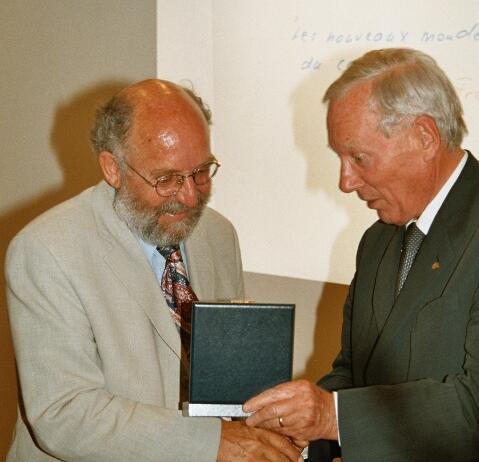
Michel
Mayor and Peter Fricker at the Ceremony