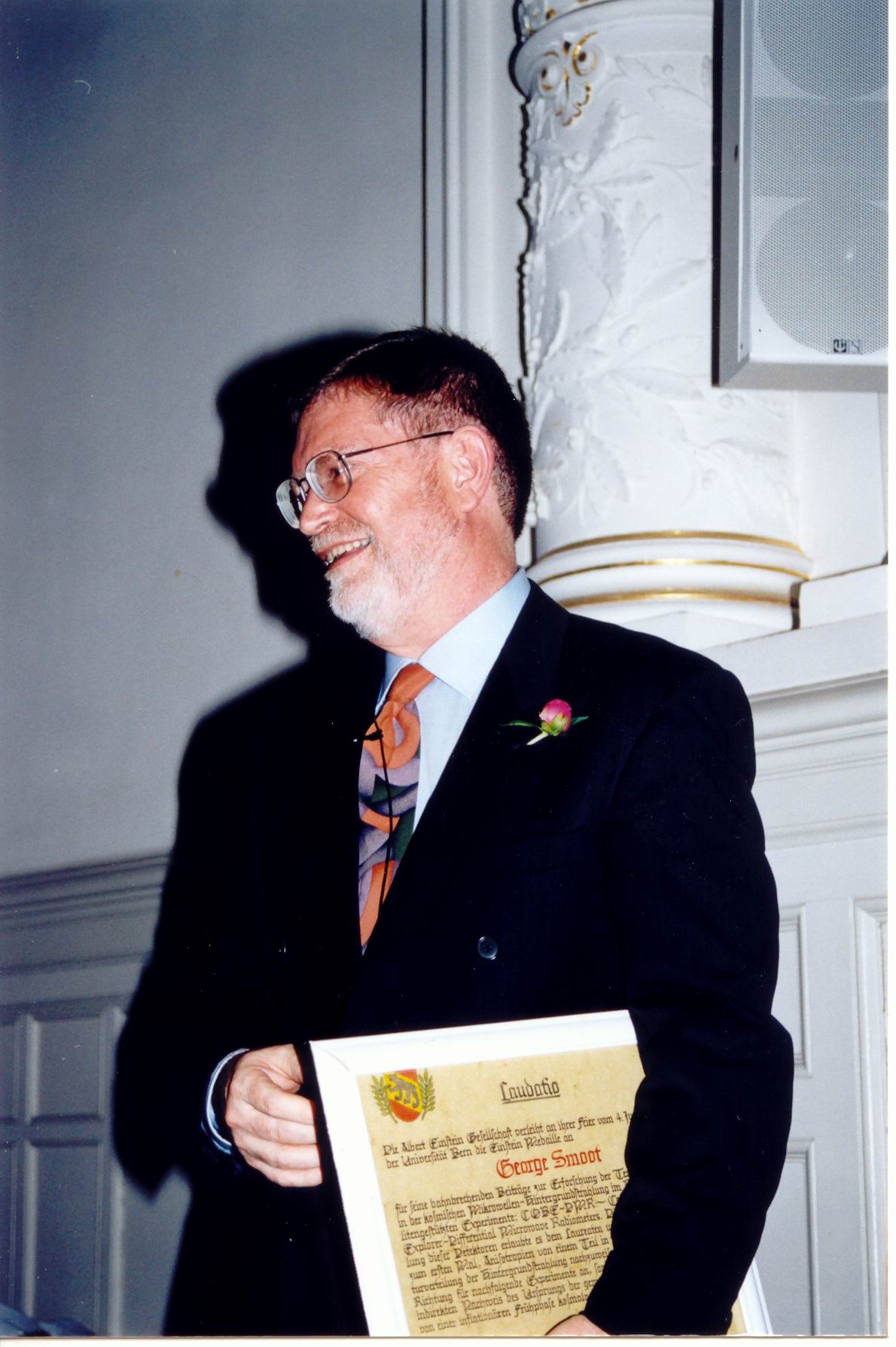
The Awarding
of the Einstein Medal on 4 June 2003 – Presentation of the laureate,
George F. Smoot
A careful photographer
of the cosmic background radiation – early fingerprints of cosmological
evolution
George F. Smoot, a
cosmologist instrumental in mapping cosmic background radiation, is this
year’s Einstein Medal laureate. He and his team have furnished revealing
data about the formation of structures in the universe with the help of
the Cosmic Background Explorer (COBE).
George Fitzgerald
Smoot, the oldest of two children, was born on 20 February 1945 in Yukon,
Florida. His father was a hydrologist, his mother a science teacher. As
a boy George liked science as well as engineering, science fiction novels,
and sports. By the time he reached high school, his interests had swayed
from football toward academics.
Soon after entering the Massachusetts Institute of Technology (MIT) he
decided to major in mathematics and physics. For his B.S. thesis he chose
a topic from elementary particle physics, and his doctoral thesis, completed
in 1970, dealt with the decay of subatomic particles. At that time particle
physics was a popular field among students. Smoot, however, was attracted
by cosmology, a discipline which, of course, has a lot to do with the
smallest particles.
Today George F. Smoot lives in Berkeley, California, where he works also
as a professor in physics at the University of California. Teaching and
scientific work leave little free time. However, he does like travelling
as well as outdoor activities like hiking, cross-country skiing. In “Wrinkles
in Time,” published in 1993, he detailed the history of cosmology
and his own experiences studying the universe. The publicity generated
by this book enabled Smoot to encourage research in the area of cosmic
background radiation.
After finishing his
Ph.D. degree in 1970, Smoot left MIT to go to the University of California
at Berkeley, where he worked on the High-Altitude Particle Physics Experiment
(HAPPE). The objective of HAPPE was to find experimental evidence of the
big bang. It takes its place among a series of experiments suggesting
the big bang, the two most famous examples being the evidence of red-shift
provided by Edwin Hubble in 1929, and the discovery of cosmic background
radiation by Penzias and Wilson in 1964. Smoot led HAPPE expeditions to
Palestine, Texas and South Dakota. The extremely faint electromagnetic
signals from space which originated 300,000 years after the big bang required
the utmost care in removing any kind of unwanted noise.
A sequence of experiments i.e. SSCM (Superconducting Magnetic Spectrometer)
or Astromag followed HAPPE. Whereas they were generally examined in search
of the existence of antiparticles left from the Big Bang, Smoot turned
his attention more and more to cosmic background radiation itself. His
question was, “Is the universe rotating, or simply expanding without
rotation?” In “Wrinkles in Time” Smoot wrote, “I
chose to work on measuring cosmic background radiation partly because
I knew this: Whatever we learned would be fundamental.”
Guided by this motto, Smoot headed various experiments in the following
years, trying to detect and interpret any piece of information, however
small, about cosmic background radiation. Such experiments are mounted
on balloons (i.e. Berkeley 90 GHz, MAX, MAXIMA, MAXIPOL), in planes (i.e.
U2), or in rockets.
In the data set of the U2 aircraft Experiment Smoot discovered a dipole
effect in 1976. The interpretation was that our Milky Way and its neighbouring
galaxies are moving at great speed toward an object of enormous mass.
This is possible without their being torn apart only if the “object”
exerting gravity is very distant, and if the area in between is more or
less empty. It was largely due to this discovery that the conception of
a universe consisting of evenly distributed galaxies was abandoned. It
looks more like space is made up of “empty” regions, with
clusters of galaxies and super clusters grouped around them in so-called
filaments.
Launched 1989, the space-borne COBE Satellite (Cosmic Background Explorer)
managed to map the temperature distribution across the whole universe
with a precision of 1/100,000 of a degree and with a resolution of 7 degrees.
Smoot was so keen on eliminating errors that he offered anyone on the
team a plane ticket to anywhere in the world if they could find a mistake
in the data!
In 1992 Smoot announced his results at the meeting of the American Physical
Society in Washington, D.C. During the three months leading up to the
conference he worked day and night preparing the COBE data. The COBE-DMR
(Differential Microwave Radiometer) allowed the discovery of anisotropies
in the primordial Cosmic Microwave Background that are the seeds of modern
structure and the birth marks from formation of the universe. These variation
observed on angular scales of 7-degrees and above by COBE promised to
reveal even more information on the Universe when observed with finer
angular resolution. The presentation of “the photograph of the universe
when it was just starting to glow” was a sensation. It was especially
Smoot’s comment “if you’re religious, it’s like
seeing God,” that touched off lively discussions among physicists,
philosophers, and theologians.
Since 1995 Smoot has been involved in a next generation Experiment, called
Planck Surveyor (scheduled launched 2007), which is a European Space Agency
(ESA) mission. "Planck" will gather much more detailed and further
information about the initial conditions for large scale structure form,
the high energy physics of the early universe, as well about the geometry
and the constituents of the universe.
(most from:
Current Biography, vol. 55, no.4, 1994)
(about
the ceremony, see http://aether.lbl.gov/www/einstein.html
)
|